Your network faces a new attack roughly every seven seconds. Research tracking 2,800 small businesses across North America found that small businesses experienced a 49% cyberattack rate in 2026, with incidents occurring every 7 seconds. That cadence means a threat arrives, probes your perimeter, and moves on, or moves in, faster than most in-house IT teams can respond. A managed firewall service sits between your network and the open internet, analyzing every connection in real time and blocking hostile traffic before it ever touches your systems.
This article explains how that protection works, when it makes sense for your organization, and what to look for in a provider.

Key Takeaways
- Misconfiguration is the real enemy: Gartner’s research on firewall breaches found that misconfiguration, not flaws in the hardware itself, causes 95% of all firewall breaches. Delegating configuration and ongoing policy management to specialists directly eliminates this risk.
- Unpatched firewalls are the ransomware entry point: An analysis of more than two trillion IT events by Barracuda Networks found that 90% of ransomware incidents exploited firewalls via unpatched software or vulnerable accounts. A managed service keeps patches up to date automatically.
- In-house management carries a measurable cost premium: Gartner Research reports that managed firewall services reduce operational costs by up to 30% compared to in-house management, reflecting both labor savings and the elimination of recurring overhead expenses. Those savings compound quickly at multi-site organizations.
- The SMB threat landscape has never been worse: VikingCloud’s 2026 survey reports that 75% of SMB owners now rank cyberattacks as their number one operational threat. Awareness alone does not produce protection; active monitoring does.
- Speed to detection matters more than ever: The CrowdStrike 2025 Global Threat Report found that the average eCrime breakout time, from initial access to lateral movement, fell to just 48 minutes, with the fastest observed at 51 seconds. A 24/7 managed service closes that window.
Quick-Start Prioritization Framework
| Strategy | Best For | Effort Level | Time to Results |
|---|---|---|---|
| Fully managed firewall service | Businesses without a dedicated security team | Low (for client) | Days |
| Co-managed firewall | Organizations with existing IT staff who want expert backup | Medium | 1-2 weeks |
| Managed NGFW with compliance reporting | Regulated industries (healthcare, finance, retail) | Low-Medium | 1-2 weeks |
| DIY firewall management | Large enterprises with in-house SOC | High | Ongoing |
| Firewall + managed detection and response (MDR) | High-risk environments, high data sensitivity | Medium | 2-4 weeks |
Start here if you are:
- A small or mid-sized business: A fully managed firewall service is the fastest path to consistent, expert-level protection without hiring additional staff.
- A regulated organization: Choose a managed provider with compliance reporting built in. Your auditors will thank you, and you will avoid documentation failures that sink otherwise solid security postures.
- An organization with existing IT staff: Co-managed or NGFW-as-a-service models let your team retain strategic control while specialists handle the round-the-clock operational work.
What a Managed Firewall Service Actually Does
The Basics: Monitoring, Policy, and Patching
A managed firewall service includes a third-party provider who configures, monitors, and maintains a business’s firewalls on their behalf, covering real-time threat detection, policy enforcement, patch management, and compliance reporting. That scope matters because each of those functions represents a gap where unmanaged firewalls routinely fail.
The policy management piece deserves particular attention. A provider can monitor logs, push patches, tune rules, and generate reports, but your organization still has to decide what traffic is allowed, what gets exempted, and who can accept the risk of a temporary opening during an incident, as outlined in this buyer’s guide to managed firewall services. Good providers walk you through those decisions rather than making them unilaterally.
Pro Tip: When evaluating a managed firewall provider, ask specifically how firewall rule changes are requested, reviewed, approved, and documented. Providers who can answer that with a defined workflow are operating at a materially higher standard than those who simply say “we handle it.”
How Threats Are Intercepted Before They Reach You
A managed firewall protects your network by monitoring traffic, identifying threats, and implementing security measures, all managed by a dedicated team. In practice, this means every data packet entering or leaving your network is inspected against a continuously updated set of rules and threat intelligence feeds.
Modern managed services almost always deploy next-generation firewalls (NGFWs) rather than traditional packet-filtering devices. According to Palo Alto Networks’ NGFW documentation, these systems inspect traffic in real time, apply behavioral analysis, and pull threat intelligence from cloud-based sources, helping detect and stop previously unseen attacks, including zero-day exploits and targeted malware.
Encryption, which threat actors frequently use to hide malicious payloads, is no longer a blind spot: next-generation firewalls decrypt, inspect, and re-encrypt SSL traffic to detect malware concealed within it. This is a critical capability that traditional firewalls entirely lack.
Why In-House Firewall Management Fails More Often Than Organizations Realize
The Misconfiguration Problem
The most dangerous assumption in firewall security is that having a firewall and managing one correctly are the same thing. They are not.
IBM Security research reports that the average breach cost has risen to $4.5 million in 2025, and more than 60% of these breaches involve firewall misconfigurations. That figure should recalibrate how organizations think about the risk of self-management. If your team configures and manages the firewall themselves, they are operating in the same category as the majority of breached organizations.
The underlying dynamic is straightforward. Firewalls remain the backbone of digital defense, yet the most common breaches still do not occur because hackers developed genius new techniques; they happen because of mistakes. Firewall misconfigurations are the silent gaps that undermine otherwise strong defenses.
In early 2026, this played out publicly. Financial technology provider Marquis confirmed a ransomware and data breach traced back to exposed firewall configurations on legacy systems. The root cause dated back months, and rather than exploiting a novel zero-day, attackers leveraged accessible configuration files, insufficient monitoring, and trust placed in perimeter controls that were no longer actively scrutinized.
The Staffing and Expertise Gap
Research from 1,200 small businesses found that 52% rely on untrained internal staff or the business owner to manage cybersecurity entirely. That is a structural problem, not a personnel one. Firewall management requires continuous expertise in an evolving threat landscape, rule set optimization, and vendor-specific platform knowledge, which is genuinely difficult to maintain internally alongside other IT responsibilities.
Managing a firewall in-house means hiring specialists at market-rate salaries, monitoring alerts around the clock, and staying current with evolving threat intelligence while your regular IT team juggles a dozen other priorities. When you add up those costs- salaries, training, certification maintenance, and emergency response- the economics shift decisively toward managed services.
Pro Tip: Calculate your true in-house firewall management cost by including staff hours spent on rule reviews, patch testing, incident response, and compliance documentation, not just the hardware and licensing line items. Most organizations find the real number is 40-60% higher than their initial estimate.

The Compliance Advantage of Managed Firewall Services
Built-In Documentation for Auditors
Compliance documentation is a major differentiator between managed and unmanaged approaches. Auditors prefer documented vendor relationships and managed change practices as evidence of compliance, and a technically well-configured open-source firewall with no vendor relationship and no formal change management process will frequently fail an audit on documentation grounds alone. This is an underappreciated risk for organizations that manage their own firewalls effectively from a technical standpoint but lack the paper trail auditors require.
Any company that processes, stores, or transmits credit card information must comply with PCI DSS. The framework requires organizations to deploy firewalls and antivirus tools to protect cardholder environments from external and internal threats. Managed firewall providers build those controls into their service and generate the logs and reports auditors need to verify them.
Regulatory Coverage Across Frameworks
A single managed provider can map one control to HIPAA, PCI DSS, SOC 2, and NIST simultaneously, avoiding the duplicated effort and conflicting configurations that come from splitting the work. For organizations operating under multiple frameworks, this consolidation is genuinely valuable; compliance becomes a byproduct of how the environment runs, rather than a scramble before each audit.
Providers like Datacate, Inc. pair managed firewall and network services with infrastructure that carries HIPAA, SOC 2 Type II, and SOC 3 compliance, as evidenced by their Rancho Cordova facility, which maintains HIPAA, SOC 2 Type II, SOC 3, and CSA STAR compliance certifications. That alignment matters for customers who need their service provider’s infrastructure to sit within the same compliance perimeter as their own systems.
What “24/7 Monitoring” Really Means in Practice
Continuous Threat Intelligence, Not Just Alerts
A common misconception is that managed firewall monitoring means someone periodically glances at a dashboard. The reality in a well-run service is considerably more active.
Next-generation firewalls deployed by managed providers use threat intelligence feeds to stay current on emerging attacks, including increasingly sophisticated AI-driven threats, and automatically update security policies.
AI and machine learning are now standard capabilities in enterprise-grade NGFW platforms, improving operational efficiency through better traffic classification, anomaly detection, and policy optimization. Combined with API-driven automation, this helps security teams respond faster and manage complex environments at scale.
Response Time as a Security Metric
The speed gap between a managed service and an in-house team is not marginal; it is decisive. Reactive “break-fix” models carry invisible risk. Every hour between an alert and a human response is an hour of exposure. Proactive monitoring, where issues are identified and addressed before users ever notice, is where the real ROI of managed firewall services lies.
Given that the average attacker completes lateral movement in under 48 minutes, the difference between a 15-minute response by a dedicated managed team and a multi-hour delay while an in-house team investigates an alert is the difference between a blocked attempt and a confirmed breach.
Pro Tip: When reviewing a managed firewall SLA, look specifically for mean time to detect (MTTD) and mean time to respond (MTTR) commitments, not just uptime guarantees. A provider promising 99.9% uptime but offering no response time SLA for security events is selling infrastructure management, not security management.
The Cost Case: What Managed Firewall Services Actually Save
Operational Overhead Reduction
Shifting to managed services can reduce in-house IT overhead by up to 40%, a critical factor for any business looking to optimize its budget, according to CloudOrbis’s analysis of managed security adoption. That reduction comes from eliminating redundant staffing overhead, licensing inefficiencies, and the expensive downtime that reactive management creates.
The hidden costs of DIY management accumulate quietly. Organizations consistently underestimate the costs of ongoing training, certification maintenance, backup staffing, and emergency response capabilities when calculating in-house security costs, with hidden costs representing 15-25% of in-house budgets.
The Cost of Doing Nothing
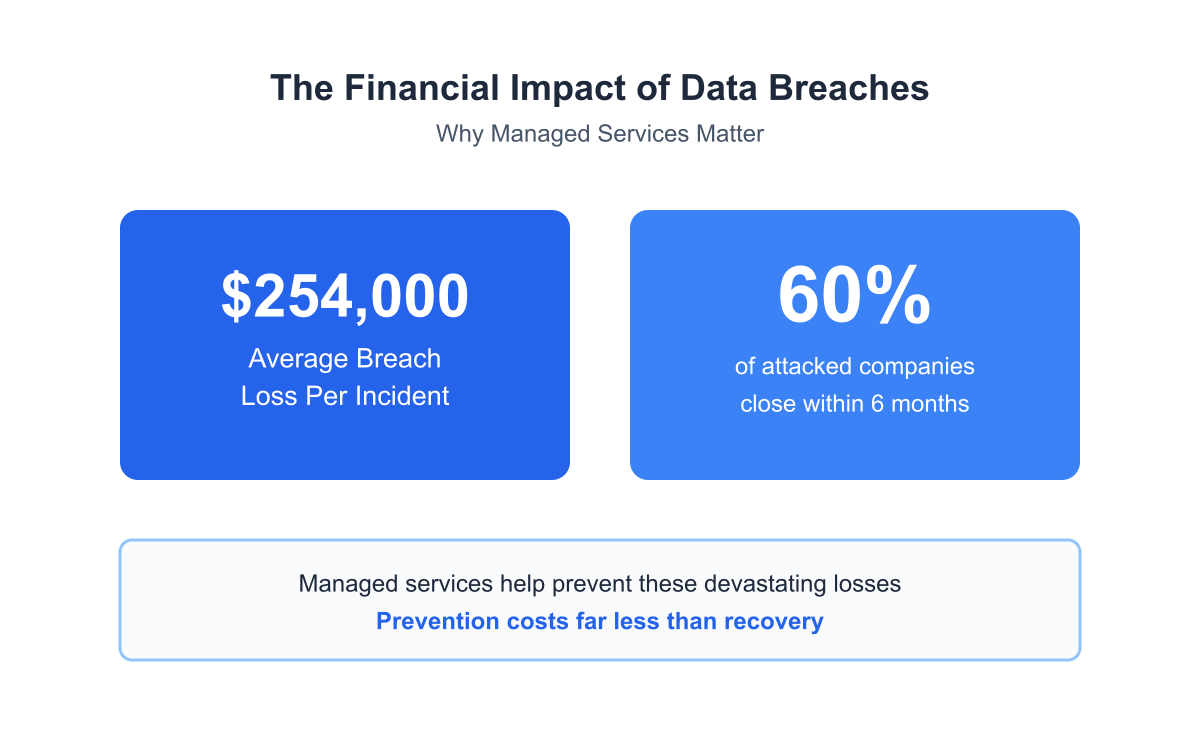
The financial argument for managed services becomes even clearer when you factor in breach costs. Average losses from a breach reach $254,000 per incident, and 60% of companies attacked close within 6 months. If a single breach carries those odds and that price tag, the monthly cost of a managed firewall service, typically ranging from a few hundred to a few thousand dollars, depending on scale, is not an expense to evaluate in isolation. It is a fraction of the risk it offsets.
A comprehensive analysis of 247 managed service providers across the United States by Tardigrade Technology reveals pricing typically ranging from $295 to over $1,650 per month, depending on specific security needs. For context, that is a fraction of the average annual salary for even a single in-house network security engineer.
Common Mistakes to Avoid When Selecting a Managed Firewall Provider
Treating All Providers as Equivalent
The managed firewall market varies widely in the depth of service. A good buying habit is to compare providers on operational clarity, not just feature lists, as noted in this managed firewall buyer’s guide. Ask potential providers to walk you through exactly what happens in the first 15 minutes of a detected intrusion attempt; their answer will tell you whether they have a practiced response or a theoretical one.
Assuming Outsourcing Transfers Accountability
Managed firewall services can support compliance, but they do not absorb it. If the logs are needed for an audit, if a rule review is required, or if an analyst needs to explain an incident to leadership, the customer still owns the answer. This means your organization needs to maintain internal governance over security policy decisions, even when the technical execution is outsourced.
Ignoring the Zero Trust Integration Question
Integration with Zero Trust architectures is important in modern environments. Managed firewall services that support Zero Trust Network Access (ZTNA) principles enforce identity-based access controls at the network perimeter, ensuring that remote users and branch connections are subject to the same policy rigor as on-premises traffic. If your provider cannot discuss ZTNA integration, they may not be equipped for hybrid and remote-work environments.
Frequently Asked Questions
What exactly does a managed firewall service include?
Managed firewall services handle the day-to-day oversight of your network security, from monitoring and patching to responding to threats in real time. Most full-service offerings also include policy management, compliance reporting, threat intelligence updates, and documented incident response procedures. The specific scope varies by provider and pricing tier, so always request a detailed service description before signing.
How is a managed firewall different from just having a firewall?
A managed firewall is a network security service operated by a third-party provider rather than by an in-house IT team. It functions like a traditional firewall, monitoring inbound and outbound traffic and enforcing security policies, but with the added advantage that configuration, analysis, and maintenance are all handled by seasoned cybersecurity professionals, as explained by SonicWall. The distinction is the continuous human and automated expertise applied to the device, not just the device itself.
Is a managed firewall service worth it for a small business?
In most cases, yes, particularly if your team lacks dedicated security expertise. Based on a survey of 1,200 small businesses, 75% say they could not continue operating if hit with a ransomware attack, and 78% fear a major cyber incident could put them out of business entirely. A managed firewall service is one of the most cost-effective ways to close that exposure without hiring full-time security staff.
Will a managed firewall help with compliance requirements like HIPAA or PCI DSS?
Data security compliance is no longer optional in a digitally driven business environment. Regulatory frameworks such as HIPAA, PCI DSS, and SOC 2 establish critical guidelines to protect sensitive data, reduce liability, and build trust, as outlined in this compliance checklist for IT systems. A managed firewall provider generates the audit logs, change documentation, and compliance reports required by these frameworks. That said, compliance responsibility stays with your organization; the provider supports it, not substitutes for it.
How much does a managed firewall service typically cost?
Pricing varies based on your environment’s complexity, the number of sites, throughput requirements, and the required inspection depth. Analysis of 247 US-based managed service providers shows pricing typically ranging from $295 to over $1,650 per month depending on your specific security requirements, according to Tardigrade Technology’s pricing study. Most providers offer tiered pricing, and the right starting point is a security assessment that maps your actual risk profile to the appropriate service level.
The Bottom Line
Threats arrive constantly, move fast, and often succeed not because they are sophisticated but because the firewall on the receiving end is misconfigured, unpatched, or unmonitored. A managed firewall service addresses all three failure modes simultaneously, providing expert configuration, continuous monitoring, and automatic patching without having to build an in-house security team from scratch.
For businesses with colocated or cloud-based infrastructure, the managed firewall layer integrates naturally with the rest of a managed services stack. Datacate, Inc. offers managed router, firewall, and VPN services alongside colocation and cloud infrastructure, with add-ons that include managed router, firewall, or VPN as part of a broader infrastructure package designed for businesses that need reliable connectivity and security in a single managed environment, as listed in their colocation service offerings.
If you are currently managing your firewall in-house and have never formally reviewed the rule set, tested the response procedures, or confirmed that patches are up to date, that is the first action to take today. If the review surfaces gaps, and it usually does, a managed service is the most reliable way to close them.
Sources
- Cyber Attacks on Small Businesses Statistics 2026, Total Assure. Tracking cyberattack frequency and financial impact across 2,800 North American SMBs. https://www.totalassure.com/blog/cyber-attacks-on-small-businesses-statistics
- How Hackers Exploit Misconfigured Firewalls, Hadrian.io. Gartner research on firewall breach root causes. https://hadrian.io/blog/fortifying-the-frontline-how-hackers-exploit-misconfigured-firewalls
- Analysis: Root Cause of Most Security Incidents Traced to Unpatched Firewalls, Security Boulevard / Barracuda Networks. Analysis of two trillion IT events collected in 2025. https://securityboulevard.com/2026/02/analysis-root-cause-of-most-security-incidents-traced-to-unpatched-firewalls/
- Managed Firewall vs. In-House: The Hidden Costs, ExtNOC. Gartner research on managed firewall cost reduction. https://www.extnoc.com/blog/managed-firewall-vs-in-house-firewall-management/
- Small Business Cybersecurity Statistics and Trends 2026, StationX. VikingCloud survey data on SMB threat perception. https://app.stationx.net/articles/small-business-cybersecurity-statistics
- Small Business Cybersecurity Statistics 2026, Medha Cloud. CrowdStrike 2025 Global Threat Report breakout time data. https://medhacloud.com/blog/small-business-cybersecurity-statistics
- What Are Managed Firewall Services and Why Do They Still Matter, Hughes. Overview of managed firewall service scope and components. https://www.hughes.com/resources/insights/cybersecurity/what-are-managed-firewall-services-and-why-do-they-still-matter
- Managed Firewall: Definition and Benefits, InvGate. Overview of managed versus unmanaged firewall approaches. https://blog.invgate.com/managed-firewall
- What Is a Next-Generation Firewall (NGFW)?, Palo Alto Networks. Technical overview of NGFW capabilities and threat detection methods. https://www.paloaltonetworks.com/cyberpedia/what-is-a-next-generation-firewall-ngfw
- Why Managed Firewall Services Beat DIY Firewall Management, METFL Services. IBM Security breach cost data and in-house management risk analysis. https://www.metflservices.com/post/why-managed-firewall-services-beat-diy-firewall-management
- Top 7 Firewall Misconfigurations Hackers Exploit in 2025, NetwiseTech. Analysis of firewall misconfiguration patterns in real-world breaches. https://netwisetech.ae/top-7-firewall-misconfigurations
- Significant Ransomware and Firewall Misconfiguration Breach, Seceon. Case study of the 2026 Marquis financial technology breach. https://seceon.com/significant-ransomware-firewall-misconfiguration-breach/
- 60 Small Business Cybersecurity Statistics to Know in 2026, Spacelift. Comprehensive SMB cybersecurity survey data including ransomware survivability findings. https://spacelift.io/blog/small-business-cybersecurity-statistics
- The Role of Managed Firewalls in Network Security, Re-Solution. Comparison of managed versus unmanaged firewall compliance documentation. https://re-solution.co.uk/the-role-of-managed-firewalls-in-network-security/
- A Guide to Managed Firewall Services for Medium-Sized Businesses, CloudOrbis. IT overhead reduction statistics for managed service adoption. https://www.cloudorbis.com/blog/managed-firewall-services
- What Is a Managed Firewall?, SonicWall. Technical definition and comparison of managed versus in-house firewall operation. https://www.sonicwall.com/glossary/managed-firewall
- Managed Firewall Services: The Complete 2026 Buyer’s Guide, ARPhost. Market sizing data and provider evaluation framework. https://arphost.com/managed-firewall-services/
- Managed Firewall Services Pricing by Company Size, Tardigrade Technology. Pricing analysis of 247 US managed service providers. https://tardigradetechnology.com/blog/managed-firewall-services-pricing-company-size-security-needs/
- What Is a Next-Generation Firewall (NGFW)? A Complete Guide, TierPoint. NGFW SSL decryption and threat intelligence feed capabilities. next-generation firewalls
- Top 5 NGFW Solutions for 2026, Nomios Group. AI and machine learning integration in enterprise NGFW platforms. https://www.nomios.com/news-blog/top-5-solutions-ngfw-2026/
- The Real Cost of Managed Firewalls, ExtNOC. Analysis of reactive monitoring risk and proactive managed firewall ROI. https://www.extnoc.com/blog/managed-firewall-services-cost/
- 2025 Compliance Checklist: HIPAA, PCI, and SOC 2 for IT Systems, ComputerBusiness.com. Compliance framework requirements for firewall and network security. https://computerbusiness.com/blog/2025-compliance-checklist-hipaa-pci-and-soc-2-for-it-systems/
- Managed IT for Cybersecurity Compliance in 2026, CompassMSP. Framework mapping and managed service compliance efficiency analysis. https://compassmsp.com/resources/articles/managed-it-for-cybersecurity-compliance-in-2026
- Data Center Facility, Rancho Cordova, CA, Datacate, Inc. Facility compliance certifications including HIPAA and SOC 2 Type II. https://www.datacate.net/gcdc-facility/