It is Friday afternoon at 4:45 PM. You are ready to close your laptop and head out for the weekend when the first report comes in: “My machine has been locked.” Then the second, and the third. By 5:05 PM, your entire infrastructure is flickering out like a dying lightbulb. The dreaded black screen appears: “Your files have been encrypted.”
For most IT managers, this is the moment they lean on their disaster recovery plan. They think, “It’s okay, we have backups.” They start the restoration process, wait twelve hours for the data to copy over, and then, just as they think they’ve won, their systems lock up again. The ransomware didn’t just hit your live data; it was sitting dormant in your backups for weeks, waiting to be “recovered” so it could reinfect the network all over again.
This is the nightmare scenario of the modern “reinfection loop.” Having a backup is no longer enough. To survive a high-stakes cyberattack, you need more than a copy of your data; you need a Clean Room Recovery Strategy.
The Great Backup Complacency
For years, the industry preached a simple gospel: Backup your data, and you’re safe. We’ve all seen the guides on what to do when you accidentally delete an important file or when a computer program crashes. Those are “soft” problems. Ransomware is a “hard” problem.
Modern threat actors don’t just “smash and grab.” They practice “dwell time.” They infiltrate your network and sit quietly for 30, 60, or even 90 days. During that time, they aren’t just stealing data; they are ensuring that every automated backup your system creates contains their malicious payload.
When you restore that data to your production environment, you aren’t fixing the problem: you’re inviting the burglar back into the house through the front door. This is why standard recovery often fails. You need a dedicated space to “wash” your data before it touches your business operations again.
The Air-Gapped Clean Room
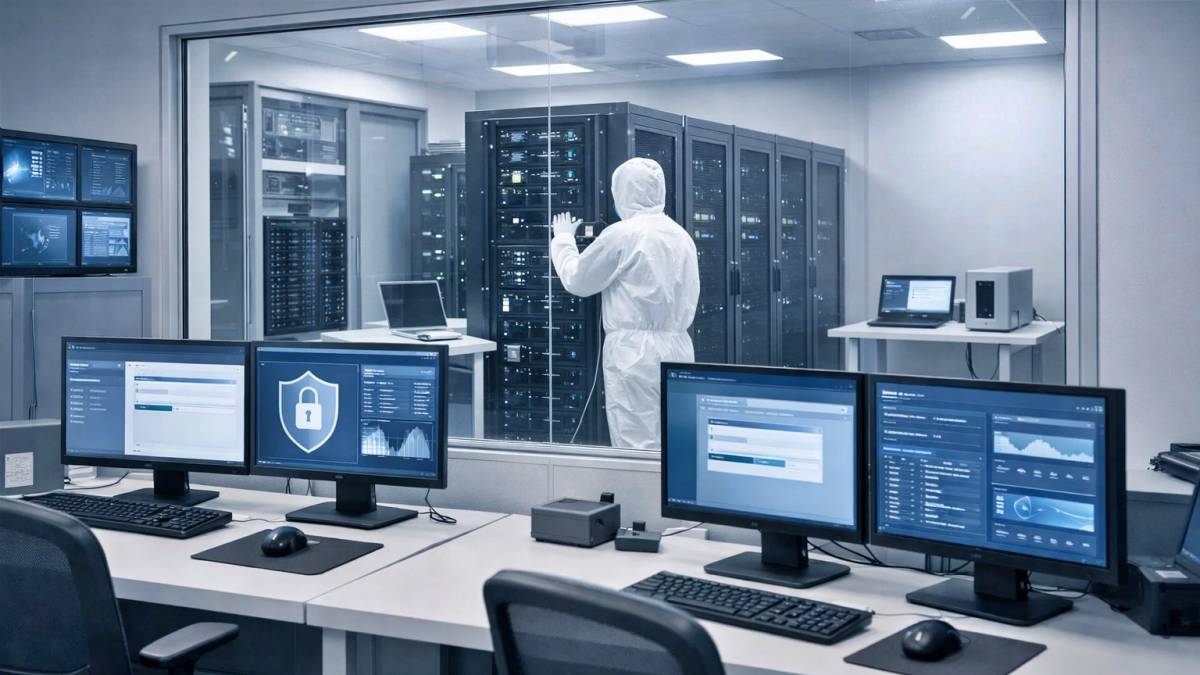
Think of an IT “Clean Room” as much like a surgical theater or a laboratory. It is a secure, isolated digital environment completely partitioned from your production network and the internet.
In a traditional setup, your backup server is often logically connected to your main network. If a hacker gets administrative credentials, they can jump from your mail server to your backup repository and delete everything. An Air-Gapped solution creates a physical or logical “moat” that prevents this lateral movement.
The Clean Room serves three primary functions:
- Isolation: It provides a sandbox where you can spin up your backed-up Virtual Machines (VMs) without them talking to the outside world.
- Inspection: It allows security tools to scan “resting” data for dormant malware or logic bombs without risking the spread of the virus.
- Validation: It gives your team a place to verify that the applications actually work before you flip the switch to go live.
If your computer is frozen, you might just reboot it. If your entire enterprise is “frozen” by a state-sponsored hacking group, you need the digital equivalent of a bunker.
The Clean Room Workflow
A true Clean Room recovery isn’t just about clicking “restore.” It is a disciplined, multi-stage process that ensures the integrity of your business.
1. The Quarantine Phase
When the attack is identified, the production environment is considered “toxic.” We pull the backups into the Clean Room: an environment that has no network path back to the infected site. This is where the air gap becomes your best friend. Even if the backup contains the virus, it has nowhere to go. It is trapped in a digital cage.
2. Deep Forensic Inspection
Inside the Clean Room, we use specialized tools to perform “integrity checks.” We aren’t just looking for the ransomware itself; we are looking for the “backdoors” the hackers left behind. This is the stage where we sort files into three buckets: Clean, Infected, or Encrypted.
3. The “Melt and Rebuild”
Oftentimes, the safest way to recover isn’t to restore the whole server, but to extract the raw data and “re-shell” it into a fresh, guaranteed-clean operating system. This prevents system-level persistence where the malware hides in the boot records.
4. Production Validation
Before any data leaves the Clean Room, we perform a “smoke test.” Does the database connect? Is the latency within acceptable limits? We treat this like a new product launch. Only after a 100% clean bill of health do we move the data back into the production environment.
Why Infrastructure Matters: The Datacate Advantage
A Clean Room strategy is only as good as the facility in which it sits. If your “Clean Room” is just another partition on the same storage array that just got hacked, you aren’t actually safe.
At Datacate, we take a “Physical First” approach to security. Because we own and operate our own data center, we don’t rely on third-party cloud providers to manage our physical security or networking layers. When we talk about an air-gap, we mean it.
SOC 2 Type II and HIPAA Compliance
For businesses in healthcare, finance, or legal services, recovery isn’t just a technical requirement: it’s a legal one. Our facilities are SOC 2 Type II and HIPAA compliant, meaning our Clean Room processes meet the highest standards for data privacy and operational integrity. We provide the audit trail you need to prove to regulators that your data remained secure throughout the entire recovery lifecycle.
Beyond “Technical Support” to “Strategic Resilience”
Many companies look for a technology consulting partner to handle mundane tasks, such as fixing a slow internet connection or configuring static IPs. And while we handle those with ease, our true value lies in high-stakes architectural resilience.
A Clean Room strategy is an investment in your company’s survival. It moves your IT posture from “reactive” to “resilient.” Instead of crossing your fingers and hoping your backups aren’t infected, you have a documented, tested laboratory where you can prove they are clean.
Is Your Business Ready?
Ransomware is no longer a matter of “if,” but “when.” As attackers become more sophisticated, the tools we use to defend ourselves must evolve as well. Simple backups are the baseline, but the Air-Gapped Clean Room is the gold standard for modern business continuity.
If you’re still relying on a “restore and pray” method, it’s time to rethink your strategy. Your data deserves a safe place to heal.
Need a partner who owns the infrastructure and the expertise to build your digital bunker? Datacate is ready to help you move beyond the backup. Let’s talk about your recovery roadmap today.